
Category: Uncategorized


INNOCENCE AND EXPERIENCE: Stuart Hampshire on morality and politics
Stuart Hampshire’s book Innocence and Experience from 1989 is one of my favorite works in philosophy. Hampshire’s star in philosophy seems to have faded somewhat, but his work deserves our continued attention. Innocence and Experience is an original and provocative work of philosophy. It is also a testament to its author’s humanity, experience, and wisdom.
The book brings together and elaborates ideas about morality that Hampshire had first voiced in earlier years. It has illuminating things to say about the importance of conditional judgments in morality and elsewhere, about the difference between substantive and procedural justice, and the role of imagination in moral thinking. Hampshire’s critique of Aristotle’s psychology with its overemphasis on reason is well-taken. So is his criticism of Hune’s detached treatment of morality. And so is also his critique of John Rawls’ attempt to pin down substantive principles of justice.
Hampshire is particularly clear-sighted on the difference between morality and politics. “Observation of the politics of the immediate pre-war years, ” he writes, “first made me think about the unavoidable split in morality between the acclaimed virtues of innocence and the undeniable virtues of experience.” And he complains that “most Anglo-American academic books and articles have a fairy-tale quality because the realities of politics, both contemporary and past politics, are absent from them.” With his background as a diplomat as well as a philosopher, Hampshire is keenly aware of the difficulty of maneuvering the gap between moral principles and the practical necessities of human politics. There is, he thinks, no theoretical resolution of that issue. “Once again the philosophical point to be recorded is that there is no completeness and no perfection to be found in morality.”
Hampshire’s view of our moral virtues and capacities is expansive: “Courage, a capacity for love and friendship, a disposition to be fair and just, good judgment in practical and political affairs, a creative imagination, generosity, sensibility: tese are all dispositions and capacities which are grounds for praising men and women.” But we know, he adds that historical circumstances and personal preferences and choices limit our ability to pursue all those virtues at once. Some of them are, indeed, incompatible. “Lopsidedness is a fact of human history and therefore a fact of human nature.”
What I appreciate most in the book is that Hampshire is writing from a broad range of human experience. His book gives testimony to a mature and humane wisdom as well as to exceptional philosophical acumen.
I remember Stuart Hampshire with gratitude as a friend and mentor and teacher of philosophy.

Xi Jinping: From collective to authoritarian government
About a year ago, at the end of 2021, The State Council in Beijing published a remarkable document with the title: “CHINA: A DEMOCRACY THAT WORKS,” It argued that China had developed a “whole process democracy” that was, in fact, superior to its Western model which consisted of an array of democratic practices at various levels of government and society.
The description of these practices was, indeed, intriguing, though one was left with the question to what extent they were implemented in a way that preserved their democratic character. At every point, the document insisted that they would of course have be “under the guidance of the Communist Party.”
But the document certainly revealed the democratic aspirations in some China’s leadership. We should certainly not take their expression for mere propaganda. The question is only whether those sentiments are shared at the highest levels of the Chinese government and specifically by its supreme leader, Xi Jinping.
What gives reasons for doubt is Chi’s apparent preference for authoritarian rather than collective government. The “Democracy” document had given an explicit endorsement of collective government. It said:
“China draws on collective wisdom and promotes full expression and in-depth exchange of different ideas and viewpoints through democratic consultation. Parties to these consultations respect each other, consult on an equal footing, follow the rules, hold orderly discussions, stay inclusive and tolerant, and negotiate in good faith. In this way, a positive environment for consultation has been cultivated in which everyone can express their own views freely, rationally and in accordance with the law and rules. Through democratic consultation, China has built consensus and promoted social harmony and stability.”
This appears to be far from Xi’s preferred way of governing as his recent re-organization of China’s government makes explicit. It was Deng Xiaoping who had implemented the system of collective leadership in order to prevent the excesses of the Mao period. In a 1980 speech Deng had criticized the “overconcentration of power” and had emphasized the need to guard against a future political strongman. Chi as now gone back on those reforms. He has, instead, taken full control of the political system arguing that a concentration of power was necessary as a solution to the acute political and economic problems faced by China.
It seems that China is right now moving further away from democracy> I wonder what the authors of CHINA: A DEMOCRACY THAT WORKS are thinking.
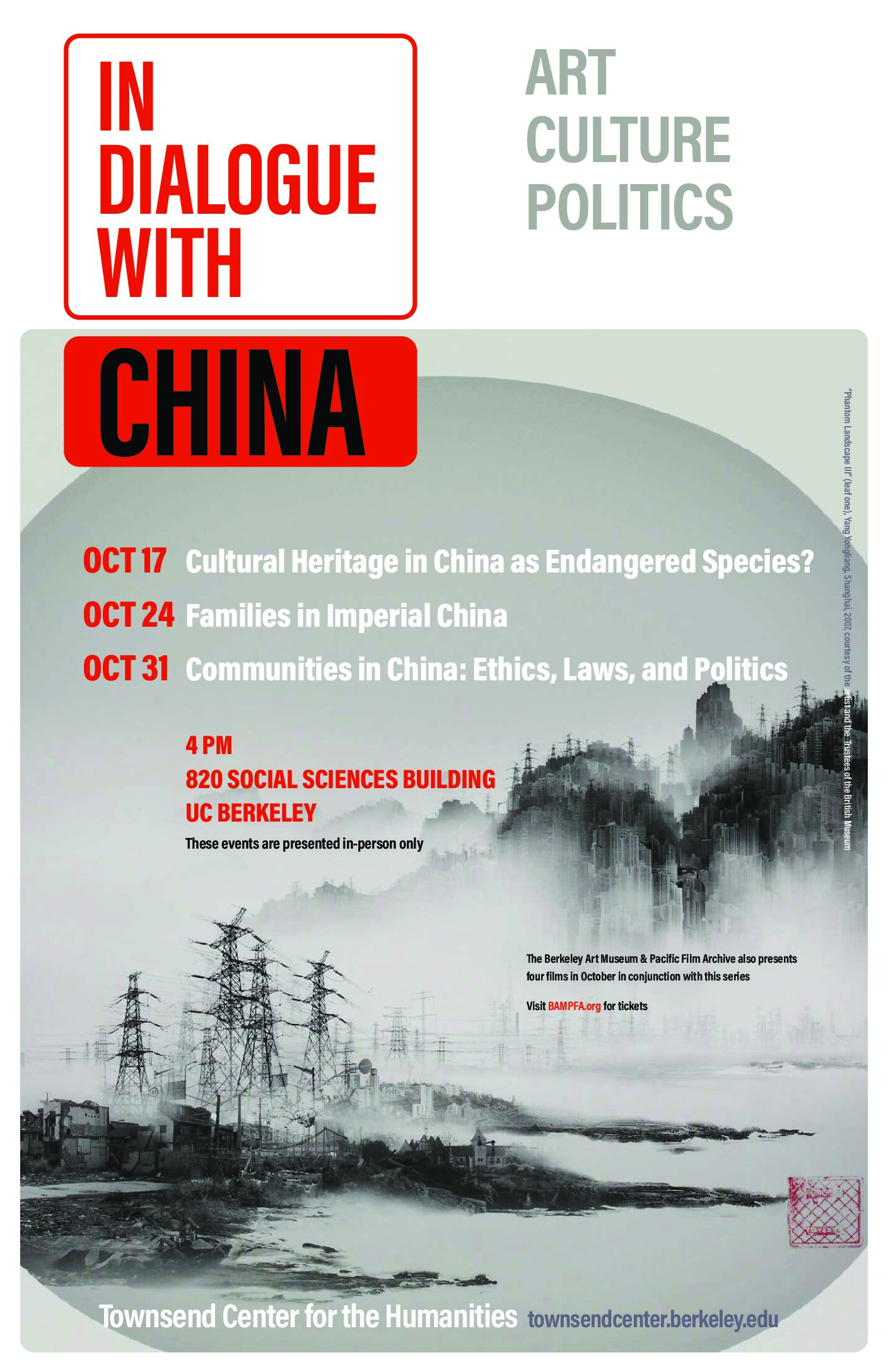
In Dialogue with China
IN DIALOGUE WITH CHINA: ART, CULTURE, POLITICS
“This yearlong series, held in Spring and Fall 2022, brings together Chinese and Western panelists to engage in cutting-edge dialogue on China’s complex contemporary reality.” Townsend Center for the Humanities
https://townsendcenter.berkeley.edu/events/in-dialogue-with-China